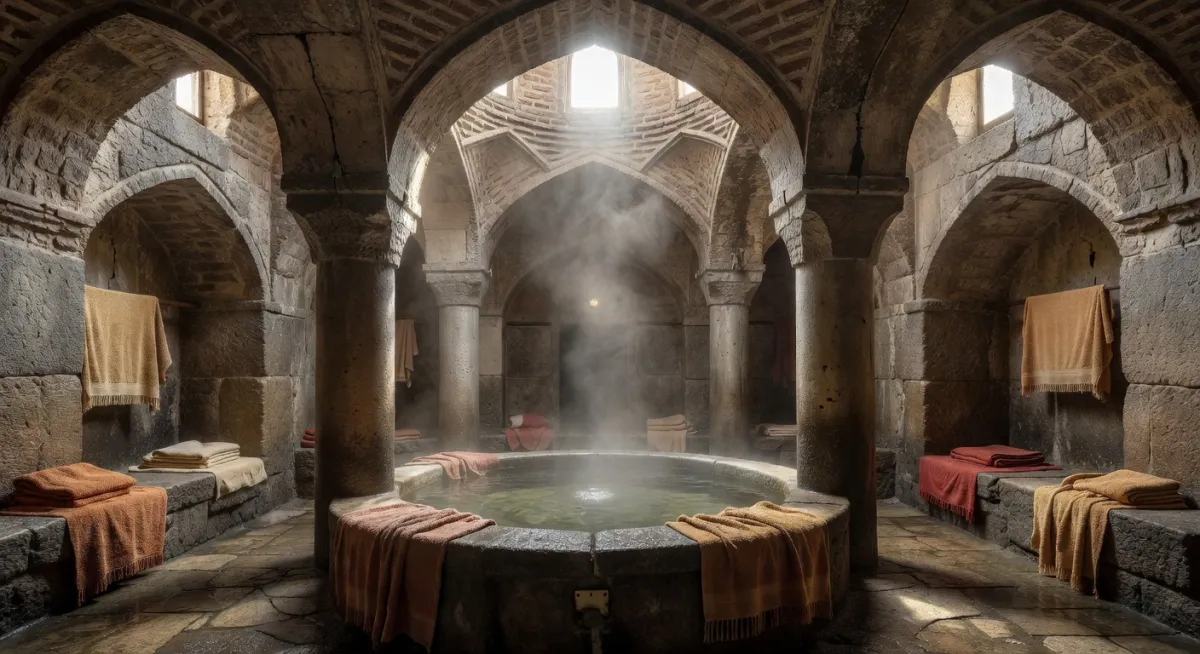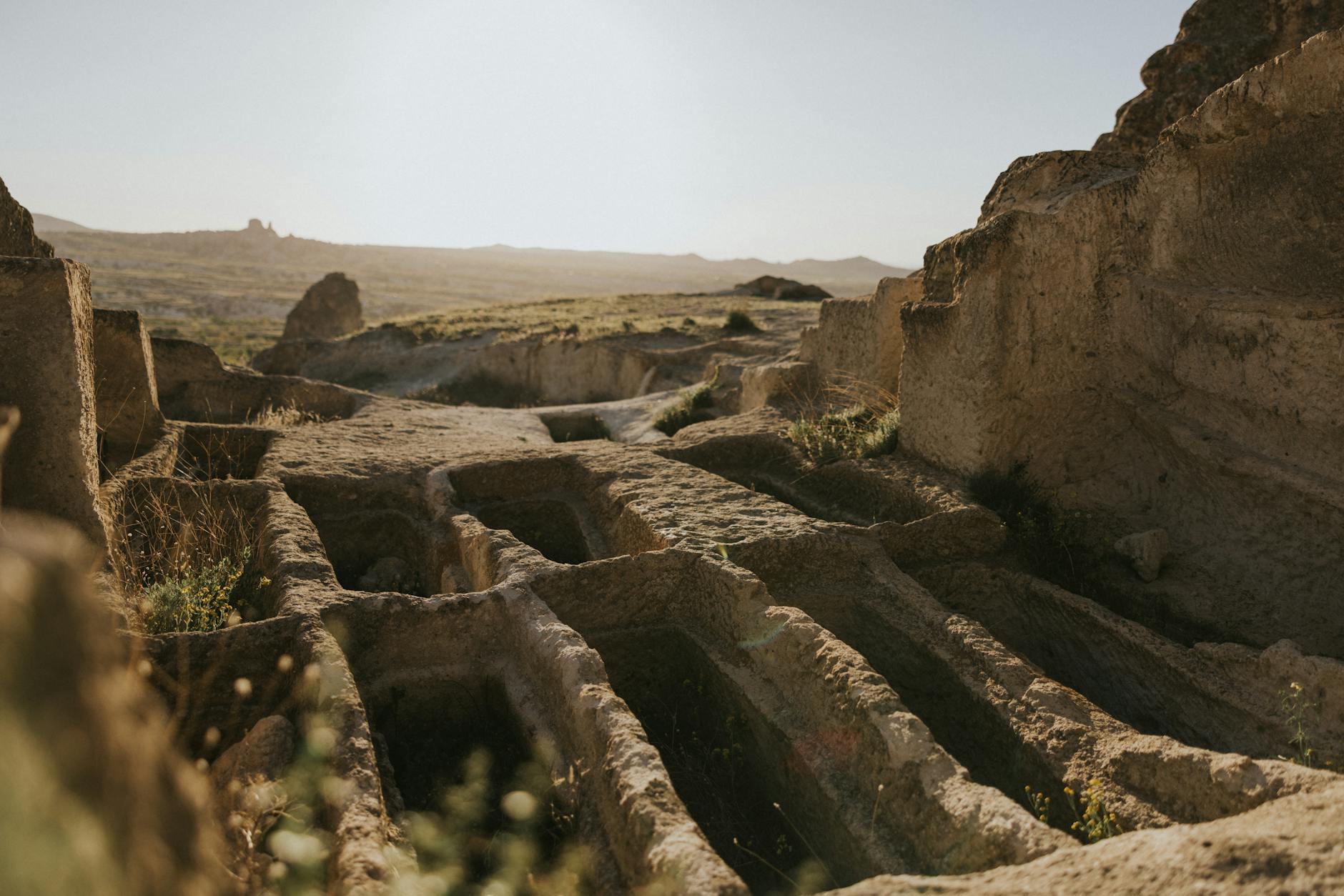
Imagine engineering a water supply system that requires no pumps, no electricity, and almost no energy input — one that moves water reliably across dozens of kilometers of scorching desert, entirely underground, and keeps working for thousands of years. This is not a thought experiment. It is the Iranian qanat, one of the most elegant and consequential engineering achievements in human history. Understanding how qanats work, and why they were built the way they were, reveals a great deal about how Persian civilization managed to take root and flourish in landscapes that should, by rights, have been uninhabitable.
What Is a Qanat?
A qanat (also spelled kanat or khanat, from the Arabic and Persian word for channel) is a gently sloping underground tunnel that carries groundwater from an upland aquifer down to a surface outlet near a village, farm, or city. The system works entirely by gravity. There are no mechanical parts. Once constructed, water flows continuously as long as the aquifer is replenished — which in many cases means indefinitely.
Qanats work by tapping into underground aquifers at a higher elevation and using gravity alone — with no pumps — to channel water downhill through a gently sloping tunnel to settlements on the plains below. The elegance of this is hard to overstate. The builders had to calculate a slope shallow enough that water would not erode the tunnel floor, yet steep enough to maintain flow across distances that sometimes exceeded thirty kilometers. They achieved this with little more than plumb bobs, careful observation, and generations of accumulated expertise.
As an Amazon Associate, I earn from qualifying purchases.
How Old Are Qanats, and Are They Still Used?
The qanat tradition in Iran stretches back at least three millennia. Archaeological and historical evidence places the earliest examples somewhere in the Iranian plateau during the early first millennium BCE, spreading outward as Persian influence expanded. The oldest known qanat in Iran, located near the city of Gonabad in Khorasan, is believed to be approximately 2,700 years old and is still operational today. That a structure built before the rise of classical Greece continues to deliver water to communities in the twenty-first century says something remarkable about both the quality of its construction and the dedication of those who maintain it.
Tens of thousands of qanats are believed to have once crisscrossed the Iranian plateau. A significant number remain active today, though modern deep-drilled wells and electric pumps have displaced many of them over the past century. Their decline is in some ways an environmental concern: qanats are sustainable by design, drawing only what the aquifer naturally replenishes, whereas motor pumps can extract groundwater far faster than it accumulates.
The Engineering Behind the System
Finding the Water
The first challenge for any qanat builder was locating a viable aquifer. This required reading the landscape — identifying alluvial fans at the base of mountains where snowmelt and rainwater percolate downward, and finding the depth at which saturated rock or gravel holds usable water. This knowledge was empirical, built up over generations, and treated as a professional secret by the specialist craftsmen who held it.
The Shaft System
Once a water source was identified, construction proceeded from the outlet end uphill toward the source — counterintuitively, perhaps, but logically necessary so that workers could maintain the correct gradient and allow excavated material and water to drain away as they dug. At regular intervals along the tunnel's route, vertical shafts were sunk from the surface. These served multiple purposes: they allowed workers to descend, removed spoil to the surface (forming the characteristic rings of earth visible from the air, which look uncannily like crater chains), and later provided ventilation and access for maintenance.
As an Amazon Associate, we earn from qualifying purchases.
The spacing of these shafts was calculated to keep the tunnel sections manageable and to ensure that airflow was sufficient for workers to breathe. The shafts also acted as survey points, allowing builders to check their alignment and slope as work progressed. Getting the gradient wrong — even slightly — over a distance of many kilometers would mean either a stagnant tunnel or one that eroded itself into collapse.
The Muqannīs: Hereditary Masters of the Underground
The construction of qanats involved specialist workers called muqannīs, who developed a hereditary craft tradition of excavating and maintaining the tunnels, working in conditions of near-total darkness. These were not ordinary laborers. Muqannīs were engineers in the fullest sense, carrying in their heads the surveying techniques, soil-reading skills, and structural knowledge that no written manual could easily convey. Their craft passed from father to son across centuries, and their social status in traditional Persian communities reflected the vital importance of their work. A village or city without its qanat was a settlement facing extinction; the muqannī who kept the water flowing was indispensable.
Working in near-total darkness, in tunnels sometimes only wide enough to crawl through, at depths that could reach eighty meters or more, muqannīs faced constant risks: tunnel collapse, suffocation from bad air, and sudden flooding if they broke into a pressurized section of aquifer. Oil lamps provided minimal light and consumed precious oxygen. The physical demands were extreme, and the mental demands — maintaining spatial awareness and gradient accuracy underground — were extraordinary.
Cities Built on Water: Yazd and the Qanat Network
No city illustrates the relationship between qanats and urban civilization more vividly than Yazd, located in the middle of the Iranian plateau and surrounded by desert on nearly every side. The city of Yazd, a UNESCO World Heritage city, developed its urban layout and architecture — including its distinctive wind catchers (badgirs) — in direct relationship with its underlying qanat network.
The badgir, or wind catcher, is a tower designed to catch prevailing breezes and direct them downward into buildings. In Yazd, these towers were often positioned directly above underground storage cisterns fed by qanats, creating a passive cooling system of remarkable efficiency: the wind catcher drew hot air out of the cistern space while cool, water-chilled air spread through the rooms below. The qanat was not just a water supply; it was the engine of an entire architectural and urban ecosystem.
Walk through the old city of Yazd today and you are walking over an invisible infrastructure. Streets follow the logic of the underground channels beneath them. Neighborhoods clustered around qanat outlets. Gardens — the famous Persian gardens, or pardis, from which the word "paradise" derives — were placed precisely where qanat water could be distributed most efficiently. The city above ground was, in a real sense, a surface expression of the engineering below it. For a broader look at the architectural innovations in Persian design that emerged from this relationship between environment and engineering, the connections run deep across Persian history.
The Spread of Qanat Technology
The qanat was not a technology that stayed quietly within the borders of the Iranian plateau. As Persian political power expanded, so did the knowledge of how to build these systems. Ancient Persian qanat technology spread westward through the Achaemenid Empire, influencing water management systems as far as North Africa, the Arabian Peninsula, and even parts of Spain.
In the Sahara, systems structurally identical to Iranian qanats — known locally as foggaras — were built to supply oasis communities across what is now Algeria and Libya. In Oman, the falaj system (plural: aflaj) follows the same basic principles and continues to irrigate date palm gardens to this day, recognized as a UNESCO World Heritage system in its own right. In Spain, the Moorish period left behind similar underground channels in the south of the country. The qanat, in other words, was not merely a Persian solution to a Persian problem. It was a genuinely transferable technology that shaped the water management of an entire belt of arid civilization from Central Asia to the Atlantic coast.
Why Gravity-Fed Water Matters
It is worth pausing on what it means that qanats use no energy input beyond gravity. In the context of ancient technology, this was the difference between a water system that could run forever and one that depended on continuous human or animal labor. A waterwheel needs a river with sufficient flow. A shaduf or Archimedes screw needs someone operating it. A qanat, once built, simply flows.
This reliability had profound social consequences. A community supplied by a qanat could plan ahead. It could develop agriculture on a scale sufficient to support non-farming specialists — potters, metalworkers, merchants, scholars, priests. The surplus generated by reliable irrigation was the foundation on which urban life, and eventually empire, could be constructed. Persian civilization did not happen despite the desert; it happened, in large part, because of the ingenuity with which Persians solved the desert's central problem.
Maintenance, Ownership, and the Social Structure of Water
A qanat was never simply a piece of infrastructure. It was a social institution. Ownership of shares in a qanat's output was a form of property, often divided among multiple families or communities. The allocation of water — who received how much, and when — was governed by elaborate customary rules that varied by region but shared a common logic: water was a common resource, and its distribution had to be managed collectively to prevent the kind of conflict that unregulated competition would inevitably produce.
The muqannīs who maintained the tunnels were paid in part from the water flow itself — a certain number of hours of water per week, or a share of the agricultural output the qanat made possible. This created a direct incentive to keep the system in good repair. A poorly maintained qanat meant less water for everyone, including the maintainers. The system was, in a meaningful sense, self-regulating.
Annual cleaning of qanat tunnels was a communal obligation. Silt and debris accumulated over time, and if left uncleared, would eventually reduce flow to a trickle. Communities organized this work collectively, and the annual cleaning cycle had a ritual dimension in many regions, tied to the Persian New Year (Nowruz) and the spring agricultural season.
Qanats Today: Survival, Decline, and Revival
The twentieth century was hard on qanats. The introduction of motorized drilling rigs made it possible to sink deep wells quickly and cheaply, and electric pumps made extracting the water effortless. For many communities, switching from a qanat to a well seemed like straightforward modernization. The costs — in groundwater depletion, in the loss of maintained engineering knowledge, in the collapse of abandoned tunnels — became apparent only gradually.
Iran has made efforts in recent decades to document, restore, and protect its remaining qanats. In 2016, UNESCO inscribed eleven Iranian qanats on its World Heritage List, recognizing them as living examples of a cultural and engineering tradition of outstanding universal value. The Gonabad qanat, that 2,700-year-old system in Khorasan, remains among the most celebrated — still supplying water, still maintained by muqannīs working in the same tradition as their predecessors millennia ago.
For researchers and engineers working on sustainable water management in arid regions, qanats have attracted renewed attention. Their core principle — drawing only what the aquifer naturally yields, at the rate gravity allows — is inherently sustainable in a way that motor-pump extraction is not. In a world increasingly concerned with groundwater depletion, the logic of the muqannī deserves serious reconsideration.
A Window Into Persian Ingenuity
The qanat is, at its core, a lesson in patient, systemic thinking. Its builders could not see the aquifer they were targeting. They could not measure their progress with precision instruments. They worked in darkness, heat, and confined spaces, guided by knowledge transmitted orally across generations. And they built something that outlasted empires, survived invasions, and continues to function today.
Understanding qanats is understanding something essential about how Persian civilization thought about the relationship between human ingenuity and natural systems — not as a contest to be won, but as a collaboration to be sustained. The water was always there, underground, waiting. The muqannī's art was simply finding it, coaxing it gently to the surface, and sharing it wisely. That, in the end, is what made the desert bloom.
Sources
Every factual claim in this article was independently verified against the following sources:
- Qanat - Wikipedia — en.wikipedia.org
- Etymological Conduit to the Land of Qanat — boloji.com
- Historic City of Yazd - UNESCO World Heritage Centre — whc.unesco.org
- Qanats Background — waterhistory.org