There is a room in Tehran that is entirely covered in mirrors — not flat, reflective sheets, but thousands of fragmented glass pieces arranged to catch light from every conceivable angle, creating the effect of standing inside a shattered star. This is the Talar-e Aineh, the Hall of Mirrors at Golestan Palace, and it tells you almost everything you need to know about the ambitions, anxieties, and aesthetic genius of Qajar Iran. Golestan Palace is far more than a royal home. It is a carefully constructed argument — made in stone, tile, stucco, and glass — about what Persia was, what it wished to become, and how it intended to be seen by a world that was beginning to look at it with imperial appetite.
A Minor Town Becomes an Imperial Stage
To understand Golestan, you first have to understand the unlikely circumstances of Tehran itself. For most of its history, it was a modest settlement in the shadow of greater cities. That changed abruptly when the Qajar dynasty made Tehran their capital in 1796 under Agha Mohammad Khan, elevating a minor town to an imperial center. The Qajars were starting, in many respects, from scratch — and Golestan Palace was their primary instrument for manufacturing imperial prestige.
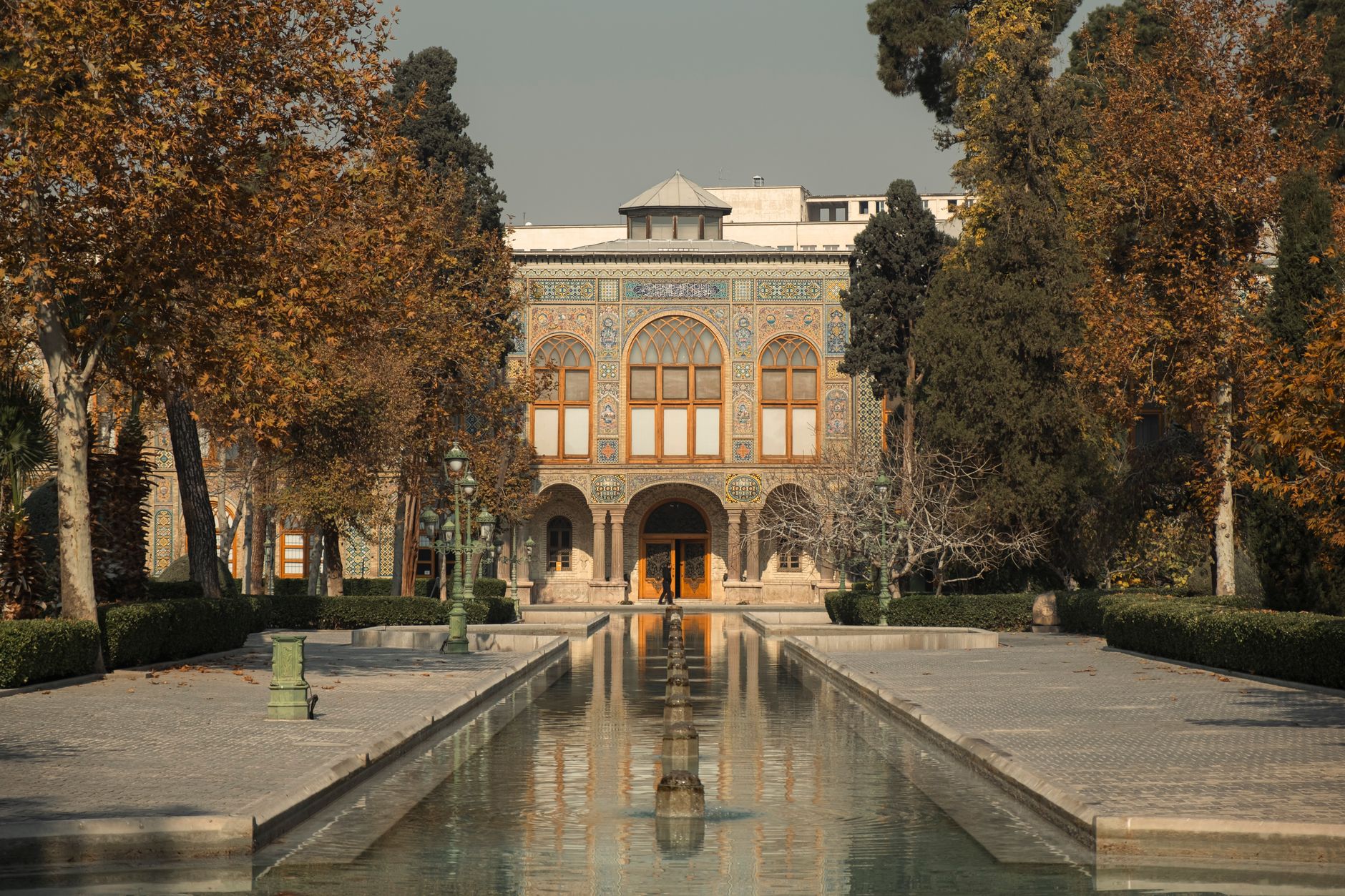
The site itself had earlier origins, with gardens and structures predating the Qajar period, but it was under Qajar rule that the complex was transformed into a coherent royal compound. The name Golestan means "rose garden," and the garden at its heart — formal, geometrically organized, threaded with shallow pools — reflects the ancient Persian concept of the paradise garden, or pairidaeza, from which the English word paradise itself derives. To build such a garden at the center of your seat of power was not merely decorative. It was a statement of civilizational continuity, a claim that the Qajar shahs stood in direct lineage with the great Persian empires of antiquity.
The Architecture of Legitimacy
The buildings that grew up around that garden over the course of the nineteenth century reflect an evolving understanding of what legitimacy required. The earliest Qajar structures at Golestan are emphatically Persian in their vocabulary: elaborate muqarnas vaulting, intricate geometric tilework in the cobalt blues and turquoises associated with Iranian ceramics, and stalactite-like plasterwork that transforms structural transitions into visual poetry. Every surface is treated as an opportunity for meaning. Calligraphic panels weave religious and literary references through the architecture, anchoring the buildings in a deep Persian cultural tradition that ran from pre-Islamic Achaemenid grandeur through the Safavid golden age.
The Shams ol-Emareh — the Sun Pavilion, completed in 1867 — marks a turning point. At five stories, it was the tallest building in Tehran at the time of its construction, and it was built partly so that Naser al-Din Shah could look out over his city. But its design also incorporated European elements — symmetrical facades with Italianate references, wind-catchers adapted from French architectural motifs — in a way that was neither wholesale adoption nor simple rejection. It was hybridization as strategy. By incorporating Western formal elements into a fundamentally Iranian structure, the Qajars were signaling sophistication, suggesting they were peers of European powers rather than subjects awaiting civilizing.
The Shah Goes to Europe — and Europe Comes to Golestan
The pace of European influence accelerated dramatically after the reign's most significant cultural rupture: direct contact with Europe itself. Naser al-Din Shah was the first Iranian monarch to travel to Europe, making three official visits between 1873 and 1889, which directly influenced subsequent additions to the Golestan complex. What he saw on those journeys — Versailles, the Crystal Palace, Viennese boulevards, Belgian royal courts — clearly unsettled and fascinated him in equal measure.
The additions made to Golestan in the later nineteenth century reflect that experience with almost documentary precision. The Dining Hall, for example, adopted European spatial conventions for formal entertaining. The Marble Throne Pavilion was expanded and refined to receive foreign dignitaries in a manner that could stand comparison with European state rooms. Portraits of Naser al-Din Shah produced during this era show him in a manner directly influenced by European royal portraiture — formal, frontal, laden with medals and regalia — while the backgrounds often include Persian architectural elements, the image itself performing the same balancing act as the buildings.
This was not mere imitation. It was a calculated recalibration. Iran in the nineteenth century faced genuine existential pressures: Russian expansion from the north, British imperial interest from the south and east, and the memory of military defeats that had already cost significant territory. Architecture and ceremony became instruments of soft diplomacy, ways of asserting that Qajar Iran was a sophisticated state deserving of respect and treaty relationships rather than conquest.
As an Amazon Associate, we earn from qualifying purchases.
The Language of Tilework and Mirrors
To appreciate Golestan fully, it helps to slow down and read its surfaces carefully, because the decorative program is anything but arbitrary. The exterior tilework on many of the Qajar-era structures features figurative panels alongside geometric and floral motifs — a departure from the stricter aniconic traditions of earlier Islamic architecture in Iran. Hunting scenes, courtly figures, and even representations of European-style soldiers appear in tile on the facades. This was deliberate: the Qajars were asserting that their court was cosmopolitan, that Persian visual culture could absorb and domesticate foreign influences rather than being overwhelmed by them.
The mirror work — aineh-kari — deserves particular attention as an architectural phenomenon. What appears at first to be pure opulence is, on closer inspection, a sophisticated material choice. Mirrored glass was expensive and strongly associated with European manufacture and luxury. By covering entire interiors with it, the Qajars were displaying purchasing power and international connection while simultaneously transforming the imported material into something distinctly Persian through the intricate geometry of its arrangement. The effect is not European rococo, though it rhymes with it. It is something stranger and more specifically Iranian — light multiplied to the point of disorientation, the self reflected endlessly back, the room becoming an argument about infinity.
The Ceremonial Heart of a Dynasty
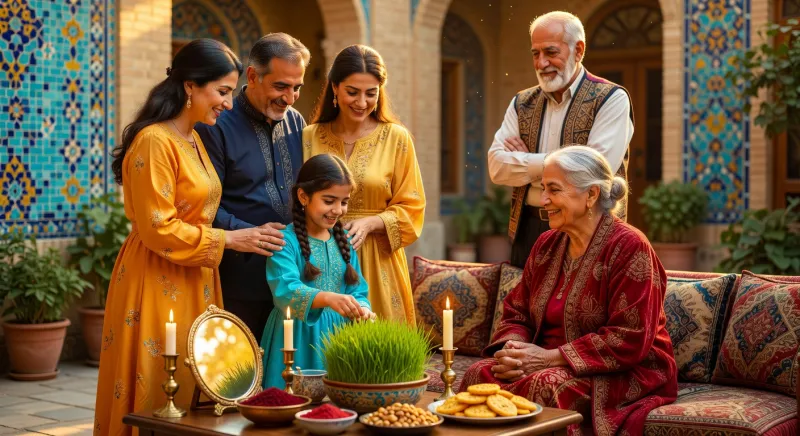
Golestan's significance was never purely aesthetic. It was the operational center of Iranian royal power, the place where the monarchy was performed for both domestic and international audiences. Official coronation ceremonies of Qajar and later Pahlavi shahs were held at Golestan Palace, making it the ceremonial heart of Iranian monarchy for nearly two centuries. The Marble Throne itself — an extraordinary object carved from sixty-five pieces of yellow Yazd marble and completed in 1806 — was the literal seat of this power, used for the formal reception of ambassadors and the public display of royal authority on Nowruz, the Persian New Year.
These ceremonies were not incidental. They were architecture by other means — choreographed events that used the buildings as backdrop and amplifier, that turned the geometry of the gardens and the glitter of the mirror halls into a stage set for sovereignty. Foreign ambassadors presenting credentials at Golestan were meant to feel the weight of a civilization that predated their own empires, while simultaneously recognizing in the European-inflected refinements something familiar enough to read as civilized on their own terms.
Reading the Complex Today
Golestan Palace today comprises a cluster of distinct pavilions, museums, and structures arranged around the central garden — not a single unified building but an accumulated landscape of decisions made across a century of Qajar rule. The Edifice of the Sun, the Brilliant Hall, the Ivory Hall, the Diamond Hall: each has its own character, its own moment of origin, its own contribution to the complex's layered argument. Walking through the compound is something like reading a long and sometimes contradictory document, one written by multiple hands under changing circumstances.
Golestan Palace was designated a UNESCO World Heritage Site in 2013, recognized as the masterpiece of the Qajar era. The designation acknowledged not just the aesthetic quality of the buildings but their historical significance — the way they embody a specific and consequential moment in the negotiation between a non-Western civilization and the forces of European modernity. That negotiation was never comfortable and never fully resolved, but Golestan is evidence that it was conducted with intelligence, ambition, and remarkable visual sophistication.
Why Golestan Still Matters
The palace complex raises questions that remain urgent well beyond Iran. How does a culture maintain its identity under external pressure without either surrendering to influence or retreating into defensive isolation? How do you build architecture that speaks fluently to multiple audiences simultaneously — asserting continuity with your own past while demonstrating engagement with an unavoidable present? The Qajar builders of Golestan did not solve these questions, but they worked on them in tile and mirror and marble with a seriousness that still commands attention.
Most royal palaces speak primarily of power. Golestan speaks of power, certainly, but also of anxiety, aspiration, and the complicated work of cultural self-definition under duress. That makes it rarer than its mirrors suggest — and considerably more interesting.
Sources
Every factual claim in this article was independently verified against the following sources:
- Golestan Palace - UNESCO World Heritage Centre — whc.unesco.org
- Qajar Iran - Wikipedia — en.wikipedia.org
- What Wondrous Sights Have Been Seen in the Brilliant Hall of Mirrors at Lavish Golestan Palace? | Ancient Origins — ancient-origins.net
- Crowning the “Sun of the Aryans”: Mohammad Reza Shah's Coronation and Monarchical Spectacle in Pahlavi Iran | International Journal of Middle East Studies | Cambridge Core — cambridge.org