On the flat, sun-bleached plain south of modern Baghdad, a single enormous arch rises from the rubble of what was once the greatest city in the world. No supporting columns hold it up. No steel reinforces its bones. It is made entirely of baked brick and mortar, yet it has been standing for roughly 1,500 years — longer than most cathedrals, longer than the civilization that built it. This is the Taq Kasra, the last visible remnant of Ctesiphon, a city that served as the imperial capital of not one but two successive Persian empires and whose fall effectively ended the ancient Persian world. Understanding why the arch still stands is inseparable from understanding why Ctesiphon mattered so profoundly.
A Capital Built at the Crossroads of Everything
Ctesiphon's location, on the eastern bank of the Tigris River in what is now central Iraq, was not accidental. The site sat at the natural convergence of Mesopotamia's agricultural heartland and the overland routes running east toward Iran, Central Asia, and ultimately China. Whoever controlled Ctesiphon controlled the flow of goods, armies, and ideas across the ancient Near East.
The city's story begins with the Parthian and Sassanian dynasties, the two Iranian imperial powers that successively made it their seat of government. The Parthians, who wrested control of the Iranian plateau from the Seleucid successors of Alexander the Great in the mid-third century BCE, established Ctesiphon as a royal winter capital sometime in the first century BCE. Its position across the river from the older Hellenistic city of Seleucia gave the Parthian kings immediate access to a functioning urban infrastructure while maintaining a distinctly Iranian royal identity.
As an Amazon Associate, I earn from qualifying purchases.
For the Parthians, Ctesiphon was a seasonal residence — grand enough to impress, but one node in a network of power. When the Sasanian dynasty overthrew Parthian rule in 224 CE, they transformed it into something far more ambitious: a permanent, monumental imperial capital befitting a dynasty that saw itself as the rightful heir to the ancient Achaemenid tradition and the dominant rival of Rome and Byzantium.
The City the Romans Couldn't Keep
Ctesiphon's geopolitical importance is underscored by how many times Rome tried to take it. Roman armies sacked the city on multiple occasions — under Trajan, Septimius Severus, and Carus — yet Rome was never able to hold it. The logistics of sustaining a garrison that deep into Persian territory proved impossible, and each time the legions withdrew, the Persians rebuilt and resumed. This recurring pattern reveals something important about Ctesiphon: it was so valuable that both sides kept fighting over it, and so resilient that it kept absorbing the damage.
At its height during the Sasanian period, Ctesiphon was not a single city but a constellation of urban settlements clustered along both banks of the Tigris, collectively known as al-Madain ("the cities") in later Arabic sources. Ancient accounts describe a sprawling complex of palaces, gardens, markets, and religious buildings serving a population that may have numbered in the hundreds of thousands — placing it among the most populous urban centers anywhere on earth at the time.
What the Taq Kasra Actually Is
Of everything that once stood at Ctesiphon, only one structure has survived in any meaningful form: the Taq Kasra, meaning roughly "the arch of Khosrow," named for the Sasanian king Khosrow I, who is traditionally credited with commissioning it, likely in the sixth century CE. What remains today is the grand iwan — a massive barrel-vaulted hall open at one end — that formed the centerpiece of the royal palace complex.
As an Amazon Associate, we earn from qualifying purchases.
The Taq Kasra is recognized as the largest unreinforced brick vault ever constructed in the ancient world. The arch spans approximately 25 meters across and rises to a height of around 37 meters — roughly equivalent to a twelve-story building — all without a single piece of metal reinforcement or a stone keystone. It was built entirely from fired brick bonded with gypsum mortar.
The engineering challenge this posed was extraordinary. A vault of this size, built from heavy masonry, generates enormous lateral thrust — the outward push that, if not properly managed, causes arches to splay and collapse. Roman and Byzantine builders typically addressed this with thick flanking walls, buttresses, or by embedding the structure within a larger complex that could absorb the forces. The Sasanian solution was different and in some ways more elegant.
The Engineering Secret Behind an Impossible Arch
The Taq Kasra was built using a technique structural historians call "pitched-brick" or "inclined-course" construction. Rather than laying bricks in horizontal courses around a temporary wooden formwork (which the Romans typically used), Sasanian builders leaned successive courses of brick at a slight angle into the wall behind them, allowing each new section to bond directly to the preceding one before the mortar dried. This meant the arch could be raised without centering — without the enormous scaffolding that would otherwise be required — and that the structure was essentially self-supporting at every stage of construction.
This approach had deep roots in Mesopotamian and Iranian building traditions stretching back millennia, but the Sasanians pushed it to a scale no one had attempted before. The choice of gypsum mortar rather than lime was also deliberate: gypsum sets rapidly, giving builders a much shorter window between laying a course and being able to load it, which was critical for an inclined-course vault where each section had to bear the weight of the next before the whole was complete.
The flanking wings of the palace that once abutted the iwan have largely collapsed, which actually reveals something the original design concealed: the surviving arch section now stands alone, exposed to wind and weather in a way it was never meant to be. The fact that it still stands, partially unsupported on its sides, is a testament to how well the structural logic of the vault itself was understood and executed. Architectural innovations in Persian design of this period consistently demonstrated an ability to translate geometric intuition into enduring built form.
The Palace as Political Statement
The Taq Kasra was never just an engineering exercise. The iwan form — a large, vaulted hall open at its front — had been developing in Iranian architecture for centuries, but the Sasanians elevated it into the defining symbol of royal power. Visitors approaching the throne hall of the Sasanian king would pass through the mouth of the great arch, dwarfed by its scale, before entering the presence of a monarch who styled himself "King of Kings." The architecture was designed to induce awe, to make the person approaching feel small against the backdrop of imperial ambition.
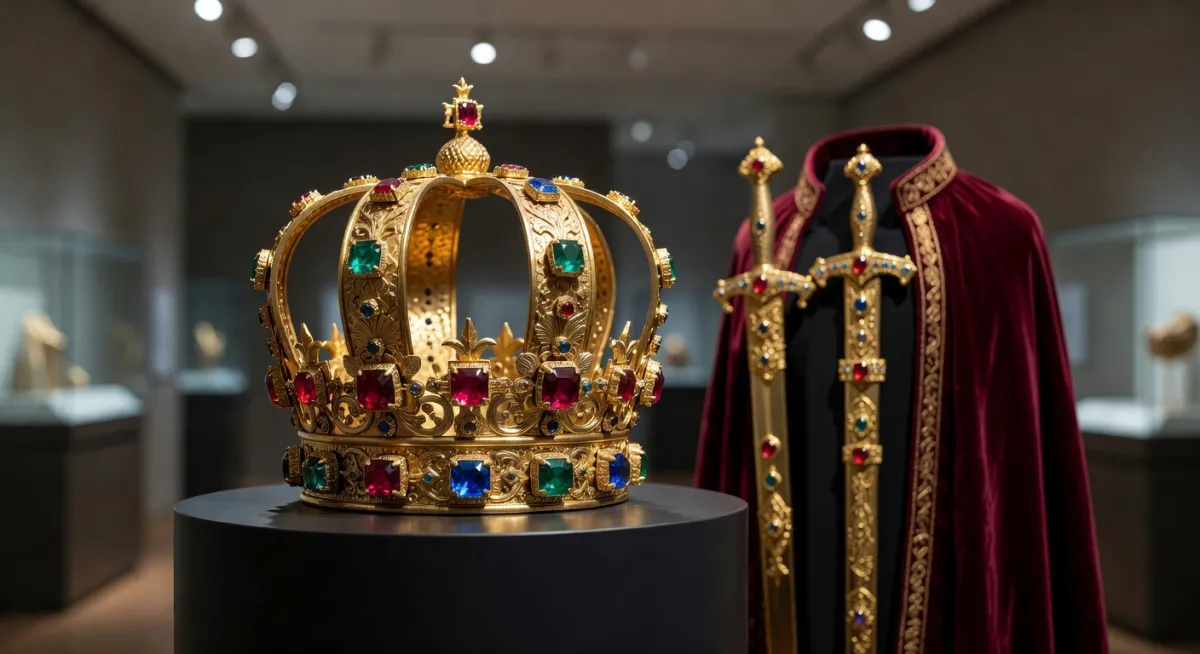
Contemporary sources describe the interior as decorated with extraordinary luxury: silk hangings, precious metalwork, and the famous "Spring of Khosrow" carpet — a massive floor covering embroidered with gold, silver, and gemstones to represent a royal garden in full bloom. When the Arab Muslim armies captured Ctesiphon in 637 CE and divided the spoils, the carpet was reportedly cut into pieces and distributed among the warriors, each fragment still worth an enormous sum.
The Fall That Changed the World
The Arab conquest of Ctesiphon in 637 CE was not simply a military event — it was a civilizational rupture. The last Sasanian king, Yazdegerd III, fled the capital without being able to mount an effective defense, and within a few years the entire Sasanian imperial system had dissolved. A dynasty that had ruled Iran and Mesopotamia for over four centuries, that had fought Rome to a standstill and presided over a sophisticated administrative, artistic, and intellectual culture, simply ceased to exist as a political entity.
The new Arab Muslim rulers initially considered making Ctesiphon the capital of their expanding caliphate, but the site presented logistical problems — flooding, an already partly damaged urban fabric — and within a few years the new garrison city of Kufa was established nearby. Ctesiphon was gradually abandoned, its brick structures quarried for building material for new cities, its palaces left to slow decay.
The Taq Kasra survived partly through neglect — it was simply too large and too structurally integrated to be easily demolished for scrap — and partly, perhaps, through a residual sense that it represented something worth preserving. Arab writers of the early Islamic period wrote about it with undisguised admiration, and it features in Arabic poetry as an emblem of the transience of worldly power, the great arch standing alone over the ruins of everything that once surrounded it.
What Remains and What Is at Risk
The Taq Kasra stands today in the town of Salman Pak, about 35 kilometers south of Baghdad. It is in a genuinely precarious state. The flanking walls that once braced the main arch have largely fallen, leaving the vault structurally exposed. Rising groundwater from Tigris flooding, the lack of consistent maintenance funding, and the damage inflicted by the instability of the region in recent decades have all taken their toll. A significant section of the northern wing collapsed in 1888, and further collapses have occurred since.
Various restoration and stabilization efforts have been proposed and partially undertaken over the years, with involvement from Iraqi authorities, international heritage organizations, and Iranian cultural institutions — a geopolitically complex collaboration given that the site represents a pre-Islamic Persian imperial legacy that sits physically within modern Iraq. The competing claims of history, national identity, and practical conservation make the Taq Kasra not just an engineering puzzle but a deeply political object.
Why Ctesiphon Deserves a Larger Place in Historical Memory
Ctesiphon suffers from a peculiar historical invisibility. It is not as well known as Rome, Athens, or even Persepolis, despite having been, for extended periods, larger and more influential than any of them. Part of this is geographical — it sits in a region that has seen extraordinary political turbulence in the modern era, making sustained archaeological work difficult. Part of it is the near-total physical disappearance of the city, leaving only the one great arch to carry the entire weight of the site's memory.
But Ctesiphon was the city where Sasanian kings received ambassadors from Byzantium and Tang China, where Zoroastrian fire temples and early Christian churches coexisted within walking distance of the royal palace, where the administrative systems that would later influence the early Islamic caliphate were developed and refined. It was a genuinely cosmopolitan imperial center whose intellectual and cultural output shaped civilizations far beyond its immediate borders.
The Taq Kasra is the last physical witness to all of that — a brick arch that has outlasted the empire that built it by nearly fourteen centuries, still performing the structural logic its anonymous engineers understood so well that no one has yet managed to improve upon it in unreinforced masonry at that scale. That it still stands is remarkable. That it is not more widely known is a loss worth correcting.