Most readers encounter the word "epic" as casual hyperbole — an epic road trip, an epic fail. But the literary term carries precise weight. Understanding what actually makes a text an epic poem opens a window onto some of the oldest human storytelling on record, and it reveals something surprising: the ancient Persian narrative tradition, stretching from sacred Zoroastrian verse to Ferdowsi's monumental Shahnameh, shares deep structural DNA with Homer's Iliad even while diverging from it in ways that matter enormously.
The Definition of Epic Poetry
The term "epic" derives from the ancient Greek word epos, meaning "word," "story," or "song," and was applied to long narrative poems celebrating heroic deeds. That origin already tells us something important: the epic began as spoken performance before it was written text. The earliest epics were not read quietly by lamplight. They were sung, chanted, or recited — often by specialist performers working from a reservoir of traditional formulas and stock scenes that could be assembled and adapted for each audience.
Scholars generally identify several defining features that separate an epic from other long poems. First, length and scope: an epic is ambitious in scale, covering not just an individual incident but a sweep of events with consequences for an entire people or civilization. Second, a heroic central figure whose virtues and flaws embody the values of their culture. Third, an elevated, formal style — a register that sets the poem apart from everyday speech. Fourth, invocation of divine or cosmic forces that shape events alongside human action. Fifth, a theme of consequence: battles, journeys, the founding of nations, the fall of dynasties.
As an Amazon Associate, I earn from qualifying purchases.
These features appear across vastly different cultures — the Mesopotamian Epic of Gilgamesh, the Sanskrit Mahabharata, the Old English Beowulf, the Homeric poems. That cross-cultural consistency is not coincidence. It reflects something about the cognitive and social function of oral narrative: large communities need large stories to hold themselves together.
What Makes Homer's Iliad the Benchmark
When Western literary criticism defines the epic, it almost always starts with Homer. The Iliad and the Odyssey were composed — or at least given the form we know — sometime in the 8th century BCE, though they drew on oral traditions centuries older. The Iliad in particular became the template against which later critics measured everything else: Virgil's Aeneid, Dante's Commedia, Milton's Paradise Lost.
What makes the Iliad structurally recognizable as epic? It has a single dominant hero (Achilles) whose personal crisis — his withdrawal from battle over a point of honor — drives the entire plot. It invokes the Muse in its opening lines. It uses repeated epithets ("swift-footed Achilles," "grey-eyed Athena") that are hallmarks of oral composition, functioning as rhythmic placeholders that also carry meaning. And it locates a private human story inside a conflict of civilizational scale.
These oral-formulaic techniques were analyzed in detail by the American scholars Milman Parry and Albert Lord in the early-to-mid 20th century. Their insight — that Homer's repeated phrases were tools of live oral performance, not signs of careless repetition — transformed how scholars read ancient poetry, and crucially, it gave them tools to recognize the same techniques in traditions far outside Greece.
As an Amazon Associate, we earn from qualifying purchases.
The Ancient Persian Tradition: How Old Is It?
The Persian narrative tradition is at least as old as Homer's, and in some forms considerably older. The Avesta, the sacred texts of Zoroastrianism, contains portions composed in Old Avestan dating to roughly 1500–1000 BCE, making them among the oldest surviving narrative verse traditions in the Iranian world. The oldest section, the Gathas, are hymns attributed to the prophet Zoroaster himself — not heroic narrative in the Homeric mold, but highly formal verse addressing cosmic questions of order, truth, and the struggle between good and evil. You can read more about the philosophical framework underpinning these texts at our page on Zoroastrian philosophical roots.
These early Iranian texts already demonstrate several features that will recur throughout Persian literary history: a formal elevated register, a cosmic moral framework that gives individual actions significance beyond the personal, and the assumption that great events unfold within a struggle between opposing cosmic principles. That last feature — the dualistic structure of Zoroastrian cosmology — would shape Persian epic storytelling in ways that distinguish it subtly but profoundly from the Greek model.
Shared Structural DNA: Where Persian and Greek Epic Meet
When scholars look at the structural features of epic across cultures, several convergences emerge between Greek and Iranian traditions. Both traditions use the heroic warrior as a vehicle for exploring the values their societies held most dear — courage, loyalty, the burden of leadership, the relationship between human choice and divine fate. Both use formal, elevated language that marks the poems as special speech. Both are rooted in oral performance traditions where memory and formula played a central role.
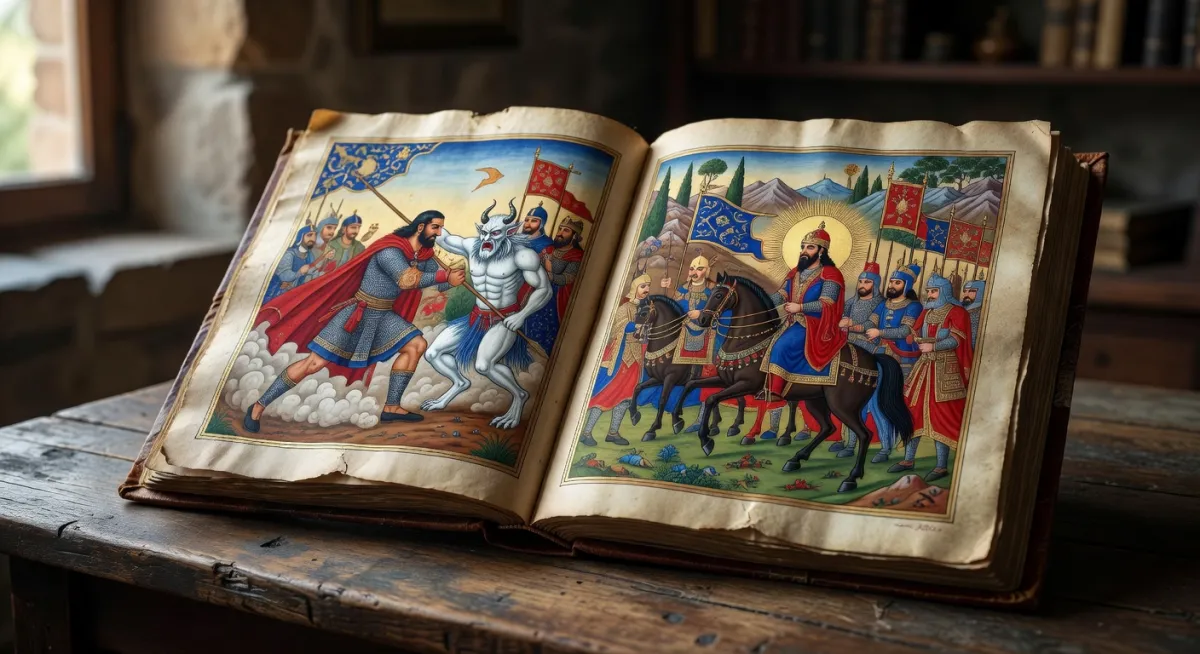
The cycle of Iranian legendary heroes — figures like Rustam, Sam, and Zal — shares something with the Greek heroic tradition in its treatment of the hero's relationship to fate. Rustam, the great champion of Iran in the Shahnameh, does not simply win his battles through skill. He is enmeshed in a tragic logic that the audience can see even when the characters cannot, and his greatest suffering comes not from external enemies but from the consequences of honor, loyalty, and terrible misrecognition. That is recognizably the world of Achilles.
Both traditions also treat the poet's role as something close to sacred. The Greek bard invokes the Muse as the true source of the song; the Persian poet positions himself as a vessel for truth and memory. In both cases, the poem is not presented as personal invention but as transmission — the poet is a conduit for something larger.
Where Persian Epic Diverges: Key Differences
The differences are as instructive as the similarities. Greek epic, especially in the Homeric tradition, tends to be focused tightly: one hero, one central conflict, a compressed time frame. The Iliad covers only a few weeks in a ten-year war. Persian epic tradition — culminating in the Shahnameh — operates on a vastly longer scale. Ferdowsi's poem covers the entire legendary and historical span of Iranian kingship, from the mythic creation of the world through the Arab conquest of Persia in the 7th century CE. It is not one hero's story; it is a civilization's story told through a succession of heroes and kings.
This reflects a different understanding of what the epic is for. Where Homeric epic centers on individual arete (excellence or virtue) and the tragedy that can flow from it, Persian epic is more dynastically and cosmically organized. The moral question is not "what should this hero do?" but "what makes a kingdom just, and what causes a civilization to rise or fall?" The Shahnameh's kings succeed when they embody divine legitimacy (farr) and fail when they lose it — a framework inherited directly from Zoroastrian theology. You can explore the full scope of Ferdowsi's achievement on our page dedicated to the works of Ferdowsi and the Shahnameh.
Persian epic also incorporates a much wider range of tones within a single work. Romance, philosophical reflection, allegory, and cosmic mythology sit alongside battlefield narrative in ways that Greek epic does not typically accommodate. This breadth would later influence the tradition of the masnavi — long rhyming narrative poems — which Rumi and others used for explicitly mystical purposes, blurring the line between heroic narrative and spiritual teaching.
The Oral Tradition and the Question of Performance
One of the most important things the epic definition reveals is that these poems were not originally literary objects — they were performances. In the Persian tradition, the figure of the naqqal (storyteller) kept the heroic cycle alive through dramatic recitation, often in coffeehouses (qahveh-khaneh), for centuries after Ferdowsi wrote the Shahnameh down in its definitive form. This is structurally parallel to the Greek rhapsode who performed Homer at festivals — the text and the performance were understood as different but related things.
This oral dimension explains one of the most debated features of The Thousand and One Nights: why it feels epic in atmosphere even though it is technically prose fiction, not verse. The frame narrative — Scheherazade telling stories to survive — is itself a meditation on the power of narrative performance. The oldest layers of the Nights draw on the same oral storytelling culture that produced the heroic cycles, with many of the same structural devices: embedded stories, repeated formulaic openings, a vast scope of human experience. The Nights is not an epic poem, but it breathes the same air.
Why the Definition Still Matters
Pinning down what "epic" means is not pedantry. It helps readers understand what these texts were doing socially and culturally — what work they performed for the communities that created and maintained them. An epic is a civilization talking to itself about what it values, what it fears, and how it wants to be remembered.
Understanding the Persian tradition as a genuine branch of the world's epic heritage — related to but distinct from the Homeric model — corrects a persistent habit in Western literary education of treating Greek epic as the origin point and everything else as derivative or exotic. The Iranian heroic tradition has its own ancient roots, its own theological framework, and its own aesthetic priorities. Where Homer asks what a great man suffers, Persian epic tends to ask what a great kingdom requires. Both are profound questions. The fact that two civilizations, separated by language and geography, arrived at the epic form as the best way to ask them tells us something important about how human minds make meaning through story.
Sources
Every factual claim in this article was independently verified against the following sources:
- Ancient Greek literature — en.wikipedia.org
- Avesta — en.wikipedia.org