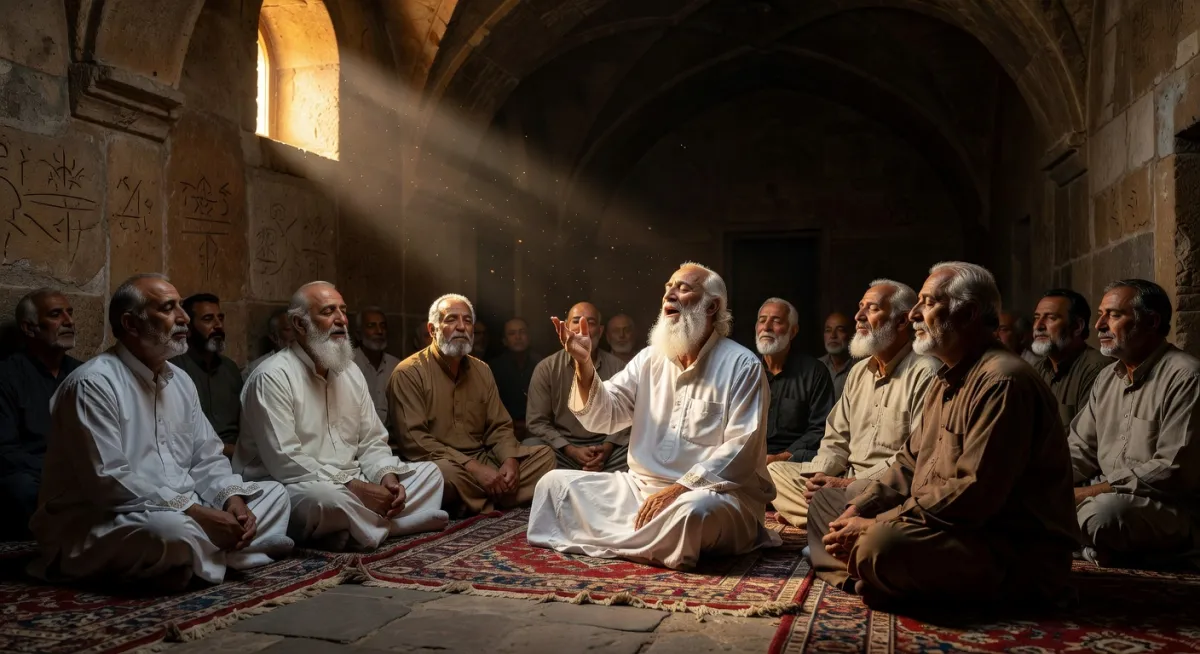
Most people encounter Rumi through a handful of lyric poems, often stripped of context and smoothed into inspirational quotes. But the work Rumi himself considered his most serious achievement was something far stranger and more demanding: the Masnavi-ye Ma'navi, a vast poem in six books that runs to roughly 25,000 couplets and deliberately resists being read in a straight line. Understanding what the Masnavi's structure and meaning are actually designed to do transforms it from an ornate curiosity into one of the most sophisticated pedagogical instruments in world literature.
What Kind of Thing Is the Masnavi?
The Masnavi is not an epic, not a lyric collection, and not a theological treatise — though it borrows freely from all three. It is a teaching text designed for oral transmission within a Sufi community. Rumi composed it in Konya (in present-day Turkey) across roughly fifteen years in the second half of the thirteenth century, dictating to his disciple Husam al-Din Chalabi, who had reportedly begged him to produce a longer work in the tradition of the great Persian didactic poets.
The result is a poem that contains fables, Quranic exegesis, philosophical arguments, jokes, ribald stories, sudden lyric outbursts, and extended theological digressions — all woven together without apparent transition. This apparent disorder is not a flaw. It is the method.
As an Amazon Associate, I earn from qualifying purchases.
The Meter as a Container for Endless Thought
Before examining the architecture of stories, it helps to understand the material Rumi was working with at the most basic level: the verse form itself. The Masnavi is written in the masnavi verse form, a Persian meter in which each hemistich rhymes with its paired hemistich (aa, bb, cc), allowing indefinite extension while maintaining rhythmic unity. This is crucially different from the ghazal form used in Rumi's shorter lyrics, where a single end-rhyme must repeat throughout the poem, constraining length.
The masnavi couplet form is, in effect, a machine for continuing. Because each couplet is self-rhyming, the poet can always add another without being trapped by an accumulating rhyme scheme. The form has no natural stopping point. This is not accidental — it mirrors the Sufi understanding of spiritual learning as a process without terminus. The poem can always go deeper because the soul's journey toward God has no ceiling.
The rhythmic pulse of the meter also served the original use context. These couplets were meant to be chanted or sung in Sufi gatherings, sometimes accompanied by instruments. The steady beat created an altered state of attentiveness — what practitioners would call a readiness for sama, or spiritual listening. Rumi was exploiting the cognitive effect of sustained rhythm to lower the reader's or listener's resistance to difficult ideas. To understand this in the context of Persian musical tradition, it helps to know something about classical Persian music instruments and the role sound played in transmitting sacred culture.
The Story-Within-Story Architecture
The most immediately striking structural feature of the Masnavi is its habit of beginning a story, interrupting it with another story, interrupting that with a digression, returning to something, and then abandoning the first thread for dozens of pages. Readers expecting linear narrative find this maddening. But there is a logic to it.
As an Amazon Associate, we earn from qualifying purchases.
Interruption as a Teaching Tool
When Rumi breaks off a story at a moment of tension, he is doing something quite deliberate. The listener's mind is left holding a question — what happens next? — while Rumi pivots to apparently unrelated material. The unresolved story creates a kind of cognitive suspension, a state of open expectancy. Then, when the original thread eventually resumes, the intervening material has reframed it. The listener understands the story differently because of what came between.
This technique is not unique to Rumi — it appears in Sanskrit narrative traditions and in frame-tale structures like One Thousand and One Nights — but Rumi deploys it specifically for doctrinal transmission. The interruption is not a digression; it is the lesson. The story that interrupts the story is often the conceptual key to understanding the outer story correctly.
The Reed Flute Prologue and the Logic of Book One
The Masnavi opens with eighteen famous couplets about the reed flute (ney), which cries because it has been cut from its reed bed. This is the poem's founding metaphor: the human soul separated from its divine origin, longing to return. Rumi then launches immediately into a story about a king and a handmaiden, which itself contains a story about a goldsmith, which opens onto an argument about the nature of divine will versus human agency.
A reader looking for plot will feel lost. But a reader following the argument — what is the nature of this longing? where does it come from? can human skill or desire satisfy it? — finds that each nested story adds a dimension to the answer. The king cannot cure his handmaiden through worldly medicine; the goldsmith thinks he can arrange the situation; both fail. The lesson accumulates through successive failures at the level of story, while the poem's voice comments, retreats, and circles back.
The Six Books and Their Spiritual Progression
The Masnavi is organized into six books, each with a prose preface addressed to Husam al-Din. Scholars have debated whether these six books represent a systematic progression or simply reflect the practical circumstances of composition. The answer is probably both.
A Loose Developmental Arc
Book One establishes the foundational problems: the soul's longing, the inadequacy of the ego (nafs), the need for a spiritual guide. Book Two deepens the analysis of the ego's resistance and introduces extended stories about prophets and their communities. By Books Three and Four, the arguments become more technically philosophical, engaging with questions about determinism, the nature of evil, and the relationship between reason and spiritual intuition.
Books Five and Six are widely regarded as the most demanding, partly because Husam al-Din's health was poor during their composition and the dictation was interrupted. They contain some of the poem's most abstract theological passages alongside some of its most earthy and comic stories — a pairing that is entirely intentional. Rumi consistently places difficult metaphysics next to stories about flatulent dervishes or foolish merchants, because one of his core pedagogical points is that the sacred and the mundane are not separate realms.
Why Six Books?
Some commentators, drawing on Islamic cosmological frameworks, have linked the six books to the six days of creation, or to the six directions of space, suggesting that the Masnavi is meant to constitute a complete spiritual universe. This may be reading too much systematic intention into what was partly an organic process. But the number is not arbitrary — Rumi understood that a teaching instrument needed enough scope to revisit its core themes multiple times, from different angles, in different registers.
How Stories Teach What Arguments Cannot
Rumi is explicit, within the poem itself, about why he uses stories rather than direct theological statement. At several points he interrupts a narrative to explain that he is about to return to it, acknowledging the artificiality of the structure. At other points he apologizes for the coarseness of a tale while insisting the meaning inside it is pure. This meta-commentary is itself part of the teaching.
The Sufi tradition he was working within — deeply informed by thinkers like Ibn Arabi and the classical tradition of Sufi mysticism in Persian thought — held that the rational mind (aql) is necessary but insufficient for spiritual knowledge. Direct statement engages the rational mind. Story engages something else: the imagination, the emotions, the capacity for identification. When you follow a character through failure and transformation, you undergo a version of that process yourself. The story does not just describe the spiritual journey; it enacts a small version of it in the reader's mind.
This is why Rumi returns to certain images obsessively — the reed, the moth and the flame, the lion and the hare, the elephant in the dark room — not because he has run out of ideas but because each repetition, in a new context, extracts a different facet of the same underlying reality. The reader who has encountered the reed image in Book One will experience it differently when it reappears in Book Three. The poem is training the reader's perception.
The Role of the Narrator's Voice
One of the Masnavi's most unusual features is its narrator, who is unstable in a productive way. Sometimes the voice is that of a wise teacher commenting calmly on events. Sometimes it is overcome with longing and breaks into lyric exclamation. Sometimes it is ironic, even sarcastic, mocking characters or pulling back from a story with a joke. Sometimes it speaks directly as Rumi, mentioning Husam by name.
This instability is not poor craft. It models the Sufi understanding of the self in spiritual development: the teacher is also a seeker; the guide is also lost; wisdom and longing coexist and alternate rather than wisdom replacing longing. By making the narrator unreliable in this specific way, Rumi prevents the reader from settling into passive reception. You cannot simply trust the narrator to tell you what to think. You are forced to engage actively — which is exactly the spiritual posture the poem is trying to cultivate.
Reading the Masnavi: Practical Guidance
For a new reader, the Masnavi is best approached not as a book to be read cover-to-cover in one direction, but as a landscape to be explored. Begin with Book One, which contains some of the poem's most celebrated sequences and establishes the central metaphors. Follow the stories even when they are interrupted, and pay attention to what comes between — the interruptions are often the payload.
A good translation with commentary is essential. Reynold Nicholson's scholarly English translation remains a standard reference. More recent translations by Jawid Mojaddedi and others are more readable while preserving theological precision. The Persian text, for those with access to it, rewards even partial familiarity, because the sound of the meter is part of the meaning in a way that no translation can fully capture.
Most importantly: expect to be confused, and treat the confusion as information. When you feel lost in the Masnavi, you are probably experiencing, in miniature, exactly the disorientation that Rumi believed was the beginning of genuine understanding.
Why the Engineering Metaphor Fits
Calling the Masnavi a teaching machine might seem to reduce it, but it is actually the most respectful way to describe what Rumi achieved. He was not simply expressing himself or displaying virtuosity. He was solving a pedagogical problem: how do you transmit knowledge that, by its nature, cannot be stated directly? How do you prepare a mind for an experience that no instruction can guarantee?
His answer was to build a text that works on multiple levels simultaneously — meter working on the body and attention, story working on the imagination and emotions, argument working on the intellect, meta-commentary working on self-awareness — and to make the structure itself a demonstration of the content. A poem about the inexhaustibility of divine meaning is itself inexhaustible. A poem about the inadequacy of the ego to grasp truth is structured to defeat the ego's desire for clean resolution.
That is why, seven and a half centuries later, scholars are still arguing about what the Masnavi means. Not because Rumi failed to communicate, but because he succeeded at communicating something that by definition cannot be finished with.
Sources
Every factual claim in this article was independently verified against the following sources:
- Mathnawi — en.wikipedia.org